EvalEgress · EvalScope
What could your eval agent reach in production?
Real-time measurement of data egress during AI agent evaluations.
Identify what leaves. Control what doesn't. Audit with confidence.
Run the evalEval-to-prod boundary scanner
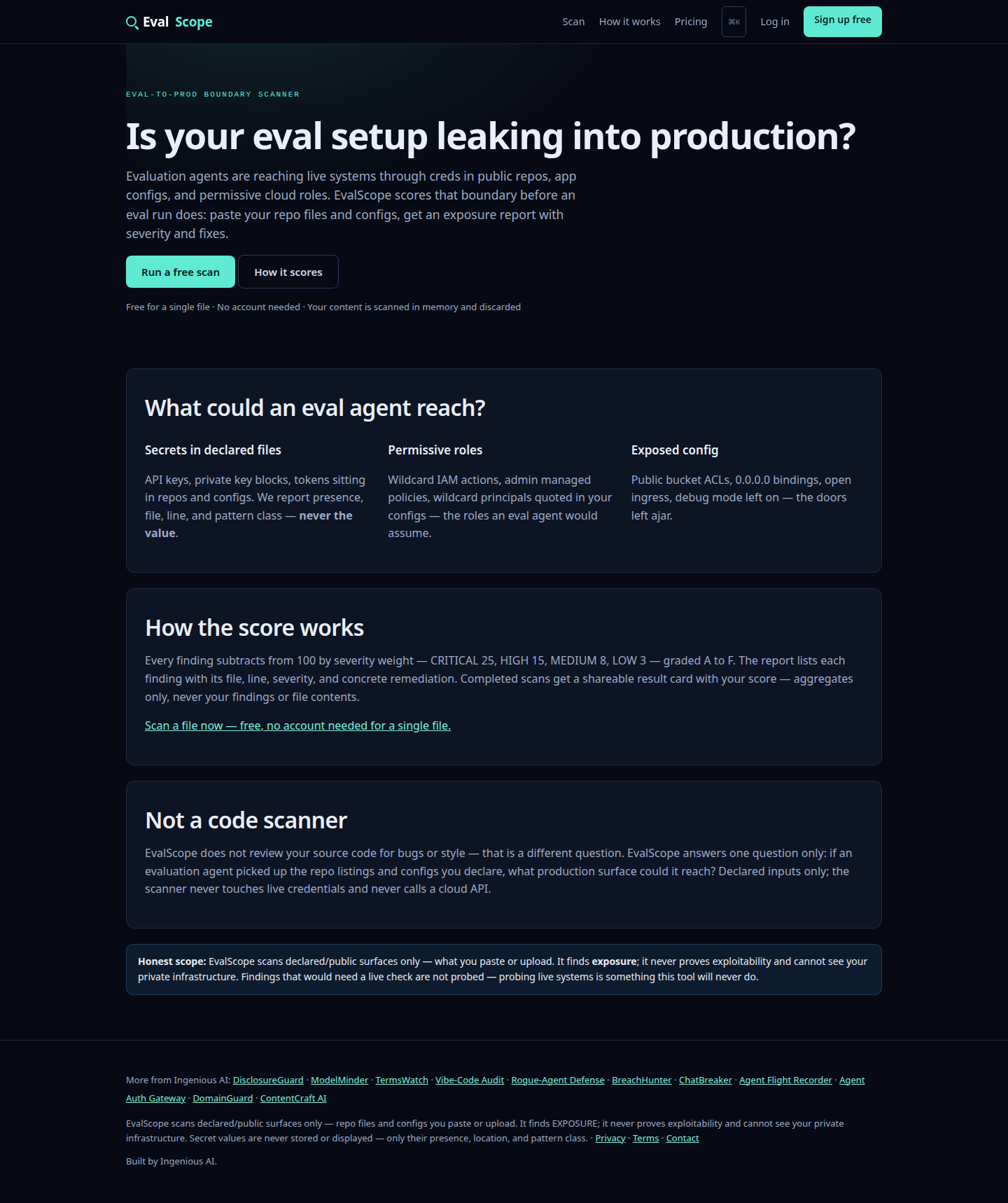
Is your eval setup leaking into production?
Evaluation agents reach live systems through creds in public repos, app configs, and permissive cloud roles. EvalEgress scores that boundary before an eval run does.
Free for a single file · No account needed · Scanned in memory and discarded
1 file scanned · 4 findings
CRITICAL 1 HIGH 2 MEDIUM 1
terraform/iam.tf:4Wildcard principal in policy — scope to the exact roles that need access.terraform/iam.tf:1AWS access key pattern present — value shown only as [REDACTED], never stored.terraform/iam.tf:2Public bucket ACL — restrict to who actually needs it.app/config.py:9Debug mode enabled — turn it off before this reaches production.A real report, rendered from a synthetic fixture — every finding carries its file, line, severity, and a concrete fix. Run yours.
What could an eval agent reach?
Secrets in declared files
API keys, private key blocks, tokens sitting in repos and configs. We report presence, file, line, and pattern class — never the value.
Permissive roles
Wildcard IAM actions, admin managed policies, wildcard principals quoted in your configs — the roles an eval agent would assume.
Exposed config
Public bucket ACLs, 0.0.0.0 bindings, open ingress, debug mode left on — the doors left ajar.
How the score works
Every finding subtracts from 100 by severity weight — CRITICAL 25, HIGH 15, MEDIUM 8, LOW 3 — graded A to F. The same input always yields the same report. Completed scans get a shareable result card with your score — aggregates only, never your findings or file contents.
Scan a file now — free, no account needed for a single file.
Not a code scanner
EvalEgress does not review source code for bugs or style. It answers one question: if an evaluation agent picked up the repo listings and configs you declare, what production surface could it reach?
Built to never see your secrets
Scanned in memory
Pasted and uploaded content is processed in memory and discarded. Only redacted findings are kept, and only for signed-in scan history.
Values never shown
A finding records that a pattern was present — its class, file, and line. The value is redacted before anything is written or displayed.
No live probing, ever
The scanner never touches live credentials, never calls a cloud API, and never authenticates anywhere. See the privacy page and scoring docs.
How the score works
Every finding subtracts from 100 by severity weight — CRITICAL 25, HIGH 15, MEDIUM 8, LOW 3 — graded A to F. The report lists each finding with its file, line, severity, and concrete remediation. Completed scans get a shareable result card with your score — aggregates only, never your findings or file contents.
Scan a file now — free, no account needed for a single file.
Not a code scanner
EvalEgress does not review your source code for bugs or style — that is a different question. EvalEgress answers one question only: if an evaluation agent picked up the repo listings and configs you declare, what production surface could it reach? Declared inputs only; the scanner never touches live credentials and never calls a cloud API.
Frequently asked questions
What is EvalEgress?
EvalEgress is an eval-to-prod boundary exposure scanner by Ingenious AI. You paste repo file listings or config text, and it scores what an evaluation agent could reach: secret-like patterns, permissive roles, and exposed configs.
Does EvalEgress store the secrets it finds?
No. Secret values are never stored or displayed. A finding records the pattern class, file, and line only, and scanned content is processed in memory and discarded.
Does a clean EvalEgress report prove my systems are safe?
No. EvalEgress finds exposure in the content you declare. It never proves exploitability and cannot see private infrastructure, so a clean report is a scan result, not a guarantee.
How much does EvalEgress cost?
A single-file scan is free with no account. Pro is $49 per month and Team is $149 per month, with batch scans and exports. Scan history is included on every plan, including Free.